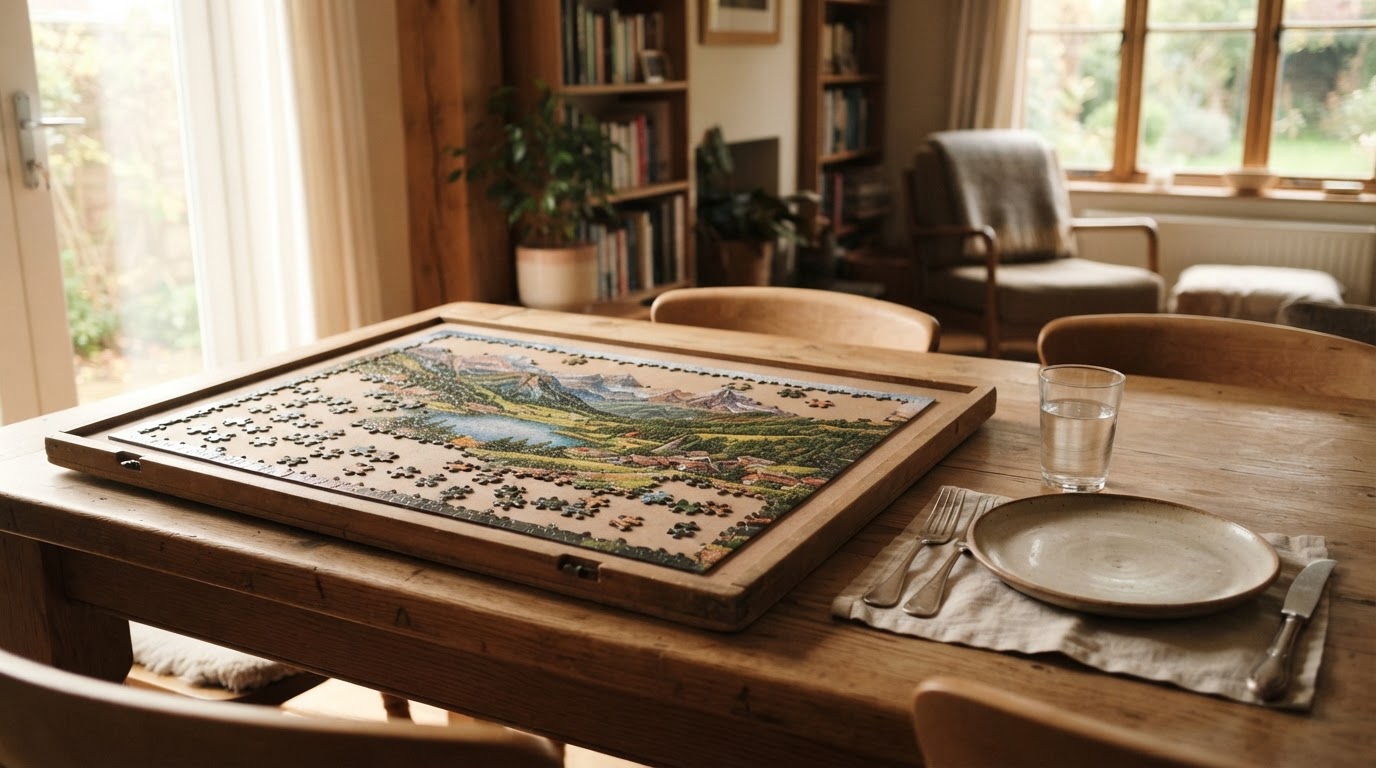
A half-finished jigsaw puzzle can take over a table for days. You finally find the piece that joins two sections, just as someone asks if the table will be free for dinner. A puzzle board gives you somewhere to build the picture and a way to pick it up as a unit. The rest of the setup has one job: make it easy to start tomorrow without sorting last night’s pieces again.
As an Amazon Associate I earn from qualifying purchases.
Picture where the puzzle would go at the moment you need the table back. Measure that route before committing to a board. The board has to pass the chair, clear the doorway and sit on the shelf with room to spare. A puzzle that fits your tabletop can still be too wide for the place you plan to keep it.
Measure the picture and the place it will wait

Find the finished dimensions on the box. Piece count is a rough guide to how long a puzzle might take, but it cannot tell you whether the image will fit a particular board. Use a measuring tape to mark the finished width and length on the table with a couple of spare sheets of paper. Leave a margin around the picture so a piece near the edge has somewhere to go when you move it. If you are buying a puzzle for a shared table, compare the finished dimensions of a compact 500-piece puzzle with the board you can actually store.
A rigid portable board is useful if you want to carry the picture to a flat shelf once dinner is ready. A low rim can catch pieces before they slide off the edge. Check the outside dimensions of the board and the usable surface inside that rim. Look for an edge you can grip comfortably and consider what it will weigh with the puzzle in place. Start with a smaller puzzle if the path to storage is awkward.
A roll-up mat may be a better fit if you have a shallow cupboard where a rigid board cannot lie flat. Follow the mat’s directions and try it with a small connected section before you roll up a large puzzle. Some pieces may shift or come apart depending on how they fit together. If you want to preserve the exact arrangement of small loose groups, move those to separate trays first.
Set aside the pieces you’ll work on next

Shallow sorting trays keep small groups separate without using half the table. Start with groups you can recognize in the picture. For a harbour scene, try sky, buildings, boats and everything else. If those categories are too broad, start with a stronger clue, like striped sails or pieces that show a thin line of white trim. Set just the tray you’re using beside your hands.
Look for trays you can stack or cover without pieces spilling between them. Small lidded containers can work if you already have them, especially for completed groups that you want to save for another day. Avoid burying pieces in a deep container if you plan to search through them repeatedly. A shallow tray makes it easier to spot a single shape, then put the rest of that group away.
Keep the reference picture visible. A box-lid stand holds the image upright when the board takes up most of the table. A compatible stand should hold the lid without bending it or letting it slip forward. If the box has a separate reference sheet, you can prop that up instead. Try the position with the board in front of you and make sure the picture is easy to see without leaning around another object.
Put the puzzle away so you can pick it up again

Before lifting a board, set loose pieces into their trays and clear the path to storage. Hold the board level with both hands, and ask someone to help if the board is awkward to carry. A fitted puzzle-board cover can help protect the work while it sits flat. Check that the cover rests on the edges as designed and leaves clearance above any trays on top. Store the puzzle where it is supported across the underside.
Leave yourself a short reminder of what you were trying to find. A scrap of paper that says “two green roof pieces” beside that tray is plenty. When you come back, start with the clue you left. If someone else is working on the puzzle with you, keep the reminder beside the reference picture so either person can pick up where the other left off.
Try the whole routine once on a weekday. Set out the board and one tray, work for as long as you like, then clear the table. Notice what costs the most time. If you keep carrying pieces separately, check whether the trays can stack. If lifting the board feels awkward, move the storage spot closer or try a smaller puzzle. The best arrangement is the one that leaves the table usable and makes you want to open the puzzle again.



Leave a Reply